SEO
Cut through the noise with straightforward, actionable SEO strategies that actually work. The industry is drowning in shiny acronyms and fake guru tactics. Here are the exact blueprints I use to verify digital assets and capture the visitor attention.
Take note: I do NOT consider my best asset to be my personal brand and disagree with folks who think like that.
John Childers was the first millionaire I met. One of the few I didn't actually have dinner with. But when exploring his psychology back then (he is retired now) he said: "Brand your name.com and what you do.com and keep them separate."
Thus, I don't invest too much into my personal brand. This page is for fun and it shows the receipts of where I have been, not so much about where I am headed. I like to have a dedicated .com for all future projects. Yeah, some shady folks using bad-faith tactics think they are the only ones who are forward thinking. But they only know what I want them to. LOL. - See, that was a jab at a specific troll.
Seriously, don't get a big head and think you need a personal brand more than a business brand. If you're a smoke stack and have a sexy tape to release like a Kardashian, then maybe you do. But for the rest of the folks, you need to get famous before you worry about branding yourself. By having a persona page, you can have fun and be ready for when you are. But out of all seriousness, no one knows who you are or will visit your site, except for maybe, your mom. But that's loyalty, not reaching a new audience, which is what we are trying to do with SEO.
I am just more forward thinking than the guy in LA going to college, or the one in the band or even the politician. I got this domain almost 30 years ago when I was working at the Microsoft Solution Provider and just before I started learning from gurus.
The Phases of SEO Relevant to Today
Phase 1 of SEO: The Foundation
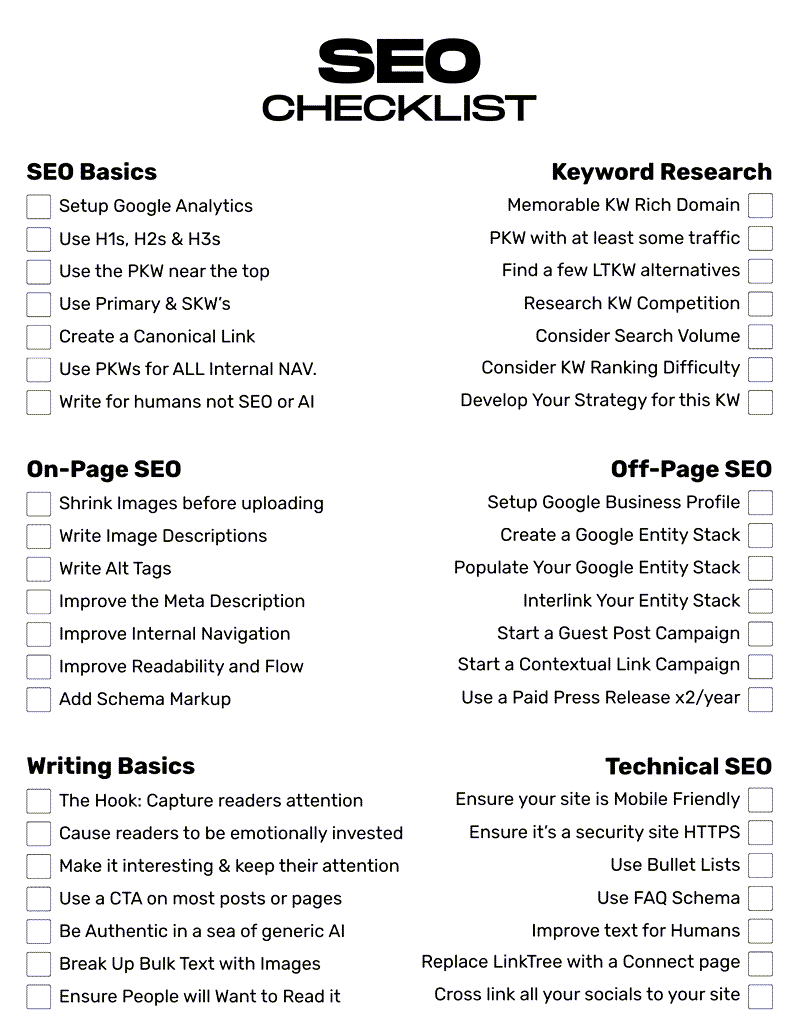
The Common Sense SEO Checklist
Technical Health: Does the site load in under 2 seconds? Is it mobile-friendly? (If not, nothing else matters).
On-Page Logic: Does the Title and H1 tag clearly state what the page is about?
URL Structure: Is it site.com/services/hvac-repair or site.com/p=123?
The "Receipts" (Content): Are you answering the questions your customers actually ask on the phone every day?
Phase 2: Advanced -The Google Entity Stack
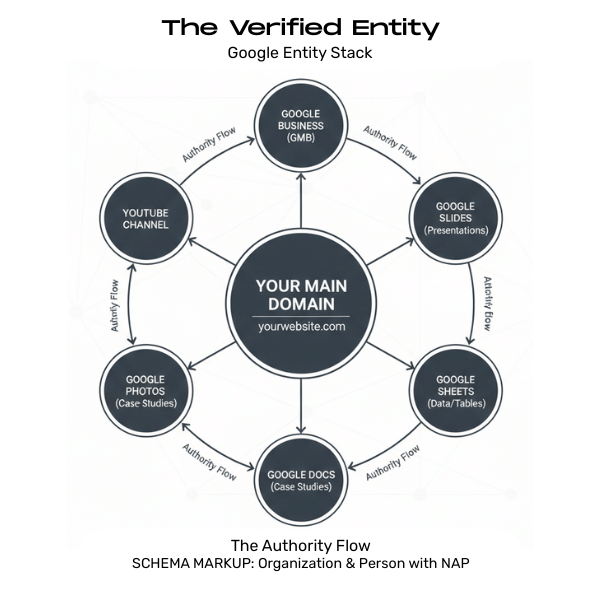
What is a Google Entity Stack?
Google loves itself more than it loves you. An 'Entity Stack' is simply the process of using Google’s own tools—Drive, Sheets, Docs, Slides, Images and YouTube—to verify your identity. By interlinking these assets and pointing them back to your main site, you are essentially telling Google’s own system: 'I am a real, verified entity.'
It’s not magic; it’s just making sure your digital ID is in order. However, this is considered old-school SEO. It will not longer work to keep your page/site on page 1. But absolutely still works to get a new page discovered quickly.
Phase 3: Don't focus on AEO / GEO, focus on DT
Right now, the digital marketing world is losing its mind over a new bowl of alphabet soup.
AEO (Answer Engine Optimization): The art of trying to become the exact "Snippet" Siri or Alexa reads out loud.
GEO (Generative Engine Optimization): The attempt to become the primary source that AI models like ChatGPT or Gemini cite in their answers.
Are they helpful? Sure, if you have a massive marketing department with nothing better to do. But for a business owner actually trying to move the needle, they are a fatal distraction.
Here is the absolute truth: AEO and GEO are just new delivery systems for the exact same foundational math. The AI engines don't care about your clever optimization tricks. They care about User Intent.
Fake internet marketers will tell you that "keywords are dead." They are lying. Keywords aren't dead; the psychology behind how you use them has just evolved. Google has mapped human behavior into four distinct states of mind. If your content doesn't match the specific intent of the searcher, you lose the click—whether it is on a desktop monitor or inside an AI prompt.
The 4 States of Search Intent:
Want to Know: The user is researching. (Target: Your Keyword)
Want to Go: The user is looking for a physical location. (Target: Keyword near me)
Want to Do: The user is looking for instructions. (Target: How to [Keyword] guide)
Want to Buy: The user has their credit card out and is ready to bleed capital. (Target: Purchase [Keyword])
You cannot anticipate every single word a human or a machine will type. But if you align your page architecture with the correct state of mind, the search engines—and the AI—will route the traffic to you by default.
Most amateurs try to jam all four of those intents onto one single page or article. It turns into an unreadable mess, and the algorithm ignores it because it lacks focus.
If you want to actually dominate a topic, you build a Keyword Cluster.
You create one central "Money Page" (your core service or product). Then, you write four separate, highly targeted articles—each one surgically designed to answer just one of those four intents. Finally, you link all four of those supporting articles directly back to your Money Page.
You just built an algorithmic spiderweb. You capture the part of your audience who is just researching, the one looking for instructions, and the one ready to buy, and you funnel all of that authority directly to your main asset.
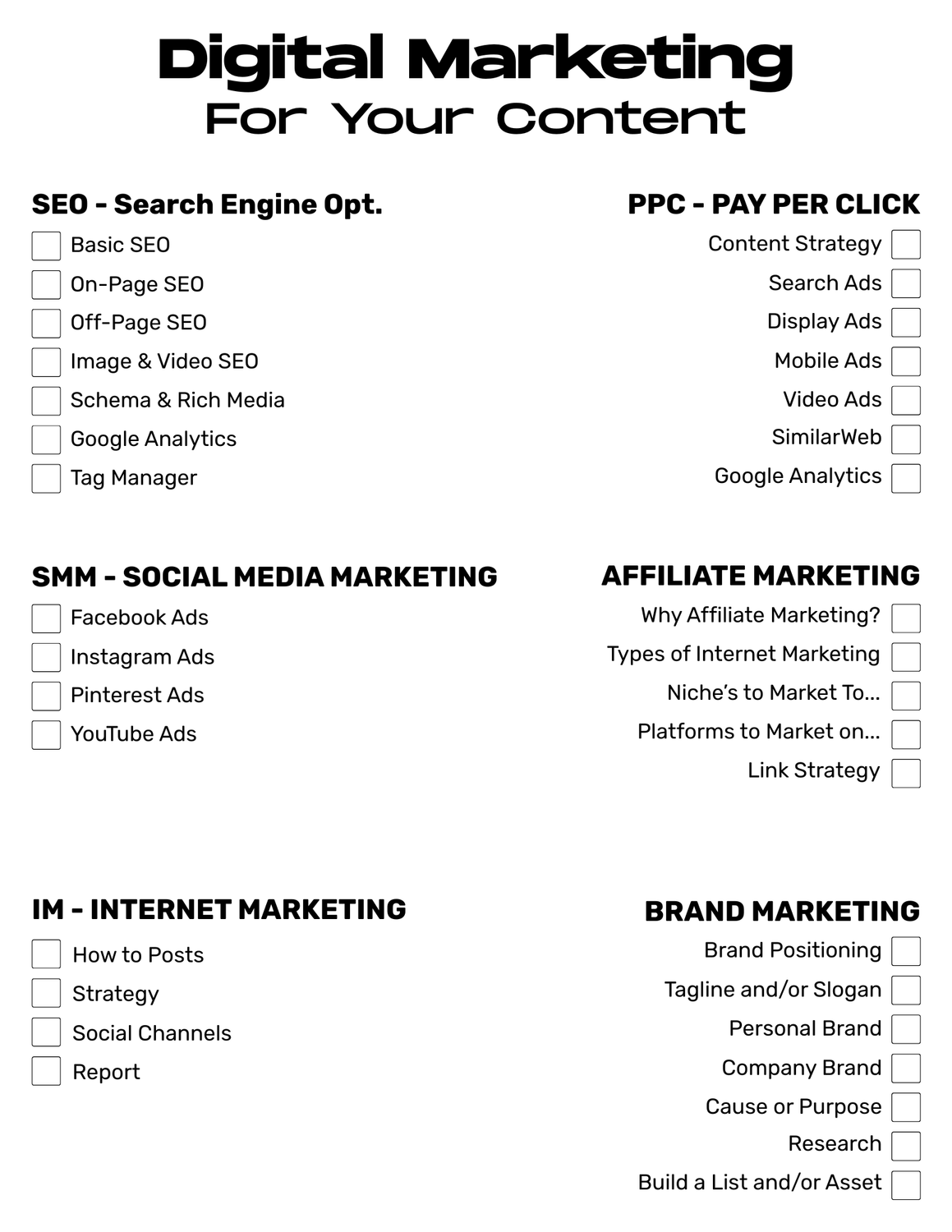
Phase 4: Scaling (The Marketing Mix)
Once your Keyword Clusters are built, conventional wisdom says you look at the "Marketing Mix" to scale. You run Facebook ads, blast your email list, and repurpose your content across social media.
That is all fine. But it is completely secondary to the only metric that actually dictates survival today: Dwell Time (DT).
You can drive all the email and social traffic in the world, but if a user lands on your page and bounces in 3 seconds, the algorithm flags your asset as trash. Dwell Time is the new reality. You have to trap the goldfish.
I am not talking about using flashing lights or cheap clickbait. The absolute highest-leverage tactic to skyrocket your DT is embedding a highly targeted video at the top of your page. It introduces the topic without cannibalizing the text, forcing the user to stay on your URL for 60 to 120 seconds before they even begin reading.
It works flawlessly for websites, and it is the exact same metric that governs the YouTube algorithm. If you aren't engineering your assets for Dwell Time, your marketing mix is just burning cash.
That is exactly why I built MomentumMatters.com.
At Momentum Matters, we don't do generic social media blasting. We run a proprietary human-in-the-loop extraction protocol. We pull the raw channel architecture and metadata directly from the source, but the actual keyword alignment and forensic analysis are strictly manual. Automated software just spits out generic scores; we build structural blueprints designed to do one thing: skyrocket your Dwell Time.
If you are ready to stop guessing and start trapping the goldfish, get out of the archives and go take the challenge at MomentumMatters.com.
Quick Answers
Where are the free PDF guides?
I got rid of them. You don't need another 50-page PDF gathering digital dust on your desktop while you pretend you're going to read it later. The exact blueprints you need to build your foundation are written right here on this page. Read the data, execute the steps, or don't.
Can I hire you for SEO consulting?
No. I don't do hourly SEO consulting or build websites for clients. My time is locked up managing my own portfolio of authority sites and running human-in-the-loop audits at MomentumMatters.com. If you want my eyes on your architecture to fix your Dwell Time, go to Momentum Matters and book an audit. Otherwise, take the free frameworks on this page and build it yourself.
Where can I see your other projects and case studies?
You can find the details on the Home and About pages. However, a large portion of my portfolio stays completely dark. I don't expose all my assets to the public algorithm just to prove a point. This page is designed to give you immediate, actionable value, not a guided tour of my entire server rack.
Chris Daniel
With a Network Administration background, this former Insurance Claims Adjuster has a knack for investigations mixed with a touch of dark and self deprecating humor. Today, as a Digital Asset Architect & Systems Investigator, Chris shares insights on social media strategies, algorithmic auditing, and insurance claims, blending technical know-how with real-world experience. Learn more about Chris and his projects on the About page.
Food For Thought
"Brand your name.com and what you do.com and keep them separate."
- John Childers
All Rights Reserved.